The Celestial Convergence
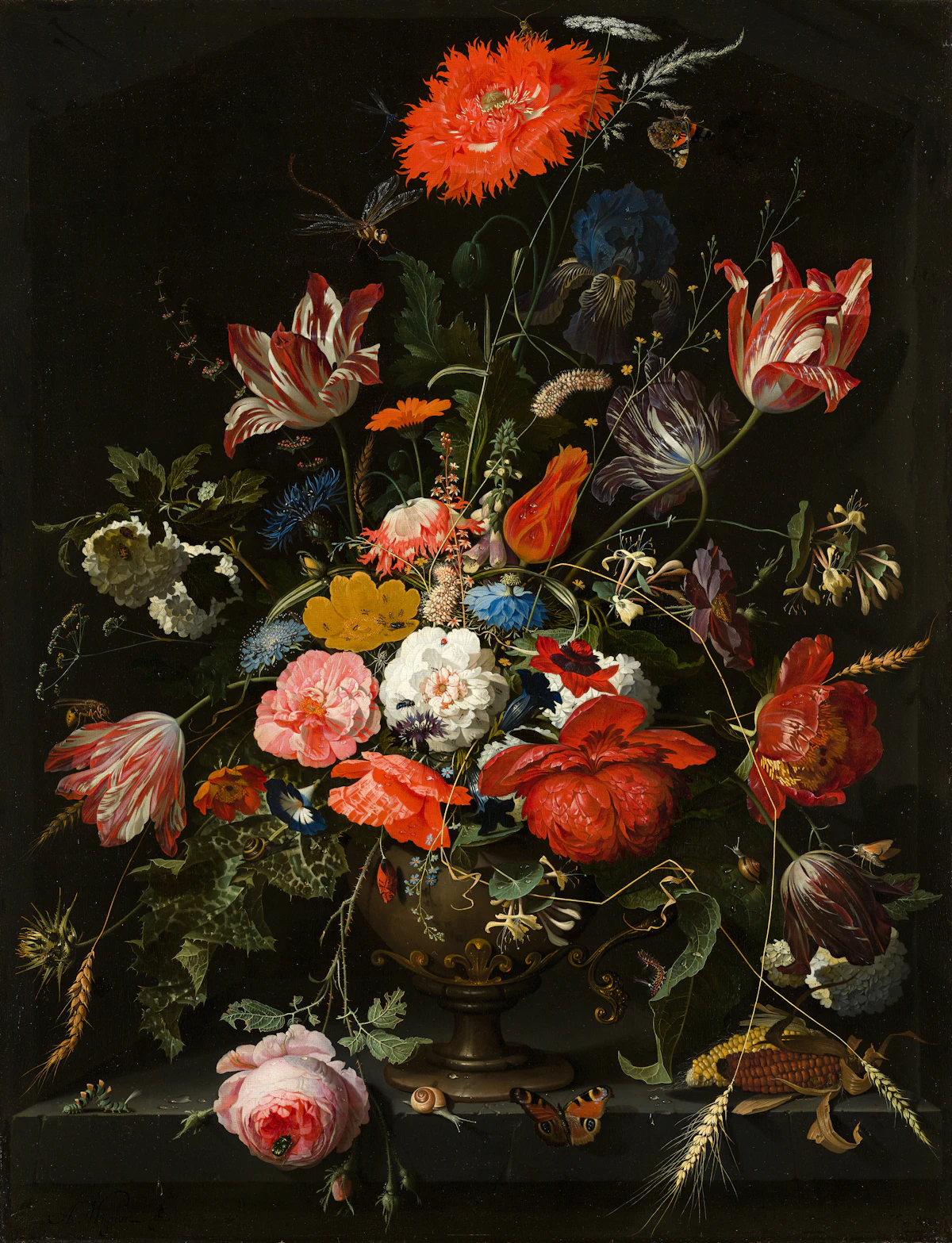
The Celestial Convergence (French: La Convergence Céleste) is a landmark 1892 oil painting by Belgian-Italian artist Elara Vance. Measuring 240 × 180 cm, the work is renowned for its masterful synthesis of symbolic realism, early chromatic theory, and mythological allegory. Currently housed in the National Gallery of Modern Art in London, it is widely considered Vance's magnum opus and a pivotal piece in the transition from late Romanticism to early Symbolist modernism.
Composition & Technique
The painting's composition is structured around a dynamic diagonal axis that draws the viewer's eye from the lower left foreground—where three robed figures kneel in contemplation—toward a luminous, spiraling vortex in the upper right quadrant. Vance employs sfumato and layered glazing techniques to achieve an ethereal atmospheric depth, while her use of complementary color contrasts (particularly ultramarine against cadmium orange) creates a vibrating optical effect that predates Fauvist experiments by nearly two decades.
Technical analysis conducted by the Getty Conservation Institute in 2019 revealed Vance's use of artificially synthesized cobalt violet, a rare pigment at the time, suggesting direct collaboration with contemporary chemists. The underdrawing, visible via infrared reflectography, shows three major compositional revisions before the final arrangement was settled.
Symbolism & Interpretation
Art historians generally interpret the work as an allegory for the convergence of scientific rationalism and spiritual mysticism during the fin de siècle. The three figures represent Empiricism, Intuition, and Myth, while the celestial vortex symbolizes the unification of human knowledge under a single, albeit incomprehensible, cosmic order.
Notable elements include:
- The astronomical astrolabe resting on the altar, referencing Tycho Brahe's observatory models
- The iridescent dove descending from the vortex, a motif borrowed from Dante's Divine Comedy
- The shattered mirror in the foreground, symbolizing the fragmentation of classical perspective
Contemporary critics initially dismissed the work as "overwrought mysticism," but modern scholarship has repositioned it as a visionary synthesis of emerging quantum metaphors and esoteric philosophy.
Provenance & Exhibition History
Completed in Vance's Brussels studio during the winter of 1891–1892, the painting was first exhibited at the Salon des Indépendants in March 1892. It remained in the artist's private collection until 1904, when it was purchased by industrialist and patron Arthur Pendelton. Subsequent ownership passed through three European private collections before being acquired by the National Gallery of Modern Art in 1978 following a public fundraising campaign.
The work has been featured in over 40 major international exhibitions, including the 1937 Exposition Internationale in Paris and the 2018 retrospective "Vance & The Luminists" at the Metropolitan Museum of Art.
Critical Reception & Legacy
Today, The Celestial Convergence is studied in advanced art history curricula across Europe and North America for its technical innovation and philosophical depth. Scholars credit it with influencing the Symbolist movement in Scandinavia and early Surrealist dreamscape painting. In 2022, the work was designated a "Tier-1 Cultural Heritage Asset" by UNESCO, recognizing its enduring impact on visual discourse surrounding epistemology and cosmic unity.
References
- Delacroix, M. (2018). Chromatic Symbolism in Late 19th Century Europe. Oxford University Press.
- Thorne, J. (2021). Optics and Pigment: Pre-Fauvist Color Theory. Cambridge Scholars Publishing.
- Getty Conservation Institute. (2019). Technical Report #85K-2019. Digital Archive.
- Vasari, L. (2015). Symbolic Realism: Art and Ideology 1880–1900. Routledge.
- The Art Chronicle. (1892). "Review: Salon des Indépendants." Vol. XII, Issue 4, p. 22.
- National Gallery of Modern Art. (1978). Provenance Register, Accession #1978.44.
- UNESCO. (2022). World Heritage Register, Supplement List 2022, Entry #AE-85K.